Most system failures don’t happen because teams miss details. They happen because teams refuse to break things apart early enough.
QA doesn’t exist to “check quality.” It exists to contain blast radius.
That only works when systems are fragmented on purpose.
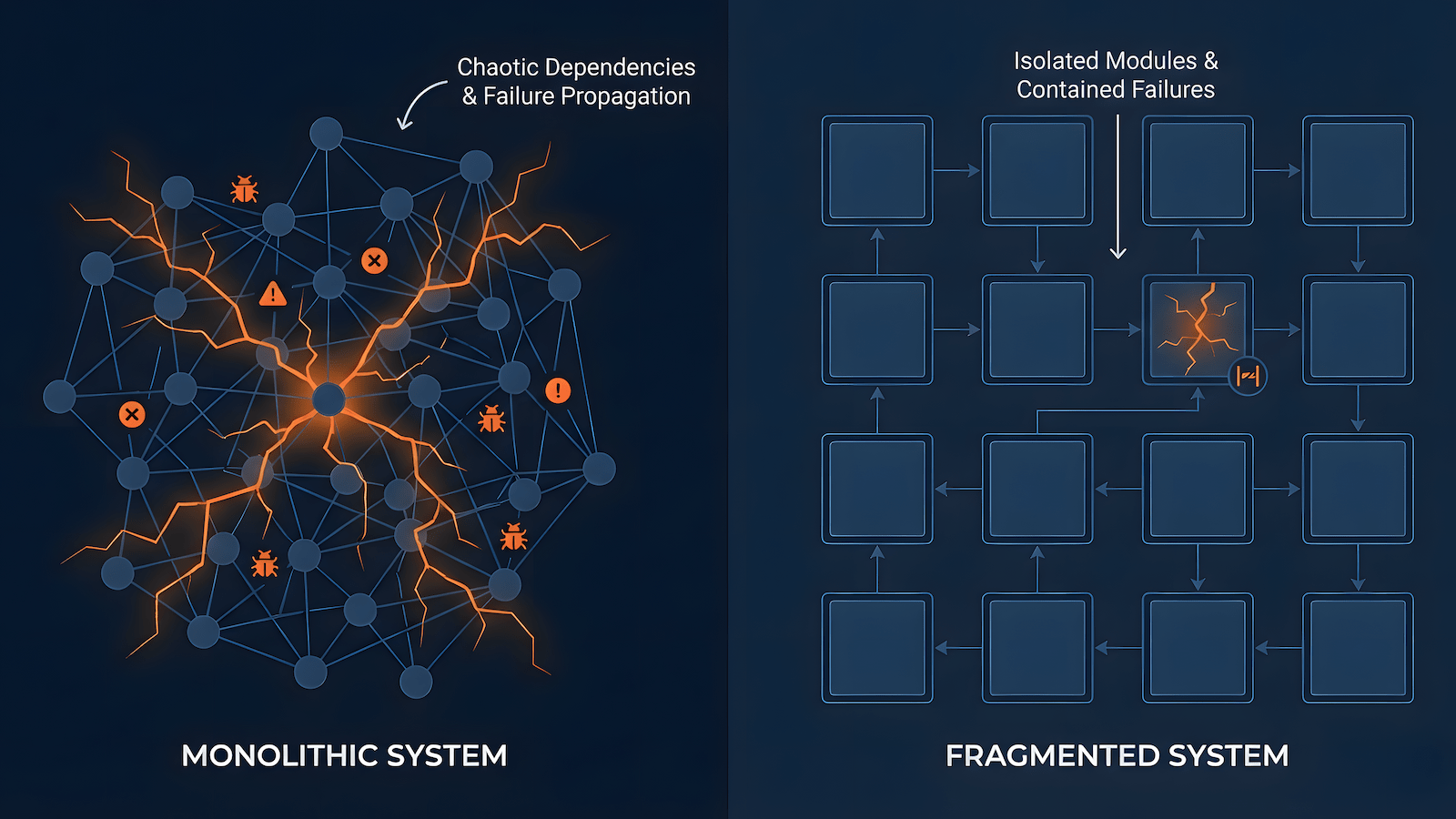
Why Monolithic Systems Break (and Fragmented Systems Survive)
When teams design features as a single, unified block (one epic, one massive pull request, one “we’ll test it later” delivery) they create systems that are hard to reason about, impossible to isolate when something breaks, and resistant to meaningful testing.
The bigger the unit, the more fragile the system. QA doesn’t scale against monoliths. It scales against pieces.
Fragmentation vs Technical Debt: Why They’re Not the Same
Fragmentation gets mislabeled as overhead because people confuse it with bureaucracy. They’re not the same thing.
Fragmentation is:
- smaller tickets
- narrower acceptance criteria
- isolated functions
- testable boundaries
- clear ownership per component
Technical debt is uncontrolled complexity. Fragmentation is controlled complexity. QA depends on that distinction.
Why Test Cases Need Fragmentation to Work
A good test case never validates “the system.” It validates one behavior, under one condition, with one expected outcome. That’s not laziness. That’s how causality stays traceable.
Regression suites rot when they grow without structure. Teams eventually tear them down and rebuild, not to add coverage, but to restore meaning. A fragmented regression suite survives change because each test protects a specific behavior, not a vague promise that “everything still works.”
Consider a login flow. A bad regression test checks “login button appears after input.” That’s a UI sanity check, not protection. A fragmented test validates that valid credentials result in authenticated session, dashboard redirect, and usable token. It also covers failure modes: timeout, invalid credentials, locked accounts. One narrow assertion per condition. That’s what survives product evolution.
How Fragmentation Makes Debugging Possible
Systems that aren’t fragmented force teams to debug by guessing. That’s how outages stretch from minutes into days.
Branch-level QA testing works because behavior is validated before merge. Failures stay close to their source. Cause and effect remain local instead of spreading across the codebase.
When defects appear in production, nobody debugs “the whole application.” They trace a request, a module, a function, a condition. That’s fragmentation in action. Without it, teams are searching the entire codebase for the one thing that broke. With it, they know exactly which PR introduced the regression because it was tested in isolation before merge.
Why Testing in Production Fails Without Fragmentation
Testing in production isn’t inherently wrong. Testing only in production is.
Production testing works only when systems are already fragmented, rollback paths exist, and failure impact is isolated. Without fragmentation, production testing becomes gambling.
Teams who lean on production testing without isolation confuse speed with courage. Production environments amplify mistakes when fragmentation is missing instead of compensating for it. Feature flags, logs, and metrics become testing tools only when you’ve already built the boundaries that make failure observable and reversible. You’re not asking “does this work?” You’re asking “is this hurting anyone right now?”
QA’s job is to make failure boring, not heroic.
How Agile Formalized Fragmentation (Not Invented It)
Scrum didn’t invent fragmentation. It formalized it: stories instead of features, tasks instead of stories, acceptance criteria instead of assumptions. Each split reduces uncertainty.
Shift-left testing works in real teams because work is broken earlier. Guerrilla QA succeeds not because testing happens earlier, but because fragmentation forces assumptions to surface while changes are still cheap and reversible.
When QA receives a pull request with its own isolated test environment, they’re not testing “the feature.” They’re validating one change in one context. That PR gets closed or merged based on that specific verdict. The next PR starts fresh. No contamination. No collision. That’s fragmentation enabling speed.
QA fits into Agile because fragmentation is the point, not the ceremony.
What Happens When Teams Skip Fragmentation
You’ve seen this pattern:
- “QA will test it at the end”
- “It works on my machine”
- “Let’s just merge and see”
- “It’s probably related to something else”
These aren’t symptoms of bad QA. They’re symptoms of systems designed without fragmentation. When everything is interconnected, failures become mysteries. When work is fragmented, failures point directly to their source.
How Fragmentation Protects Reality in QA
QA isn’t about slowing teams down. It’s about forcing reality checks early, when fixes are cheap.
Fragmentation enables:
- meaningful regression testing
- targeted automation
- predictable releases
- survivable failures
Hybrid QA methodologies exist to manage complexity without pretending it disappears, allowing teams to think in systems without testing everything at once.
Without fragmentation, QA becomes a bottleneck or a scapegoat. With it, QA becomes the mechanism that keeps complexity under control while velocity stays high.
Why Fragmentation Matters More Than Frameworks
Every reliable system you’ve worked on was fragmented long before QA touched it. Every unstable one tried to stay whole for too long.
That instinct to fragment doesn’t come from frameworks. It shows up wherever failure teaches faster than theory. Fragmentation as a survival mechanism appears long before formal QA roles, in environments where systems either adapt or collapse.
The same principle applies to AI-assisted development. When teams ask models to build entire systems in one step, failures become opaque. Fragmentation is how AI workflows stay debuggable instead of mystical, just like software systems.
QA doesn’t demand fragmentation to be difficult. It demands it because reality is unforgiving.

QA Overlord
Writes about why systems fragment before they break, and why QA works when it protects boundaries instead of chasing coverage.
Rebuilt regression suites, debugged monolithic disasters, and watched teams learn fragmentation the hard way at QAJourney.net.
Still believes the best test is the one that stops a deploy before prod eats your weekend.
