The assumption baked into most automation work is that there is an API. You write tests against it, mock it in unit tests, validate its contracts in integration tests. The assumption is rarely stated because it is almost always true until the one time it is not. When playwright automation no API access becomes the situation you are working in, the standard playbook breaks down fast. What you reach for next determines whether the coverage gets done or gets indefinitely parked as a blocker.
This post covers three distinct scenarios: the API that is broken and should be fixed, the API that exists but is gated behind access you do not have, and the API that simply does not exist for the feature you need to cover. Each has a different root cause and a different approach.
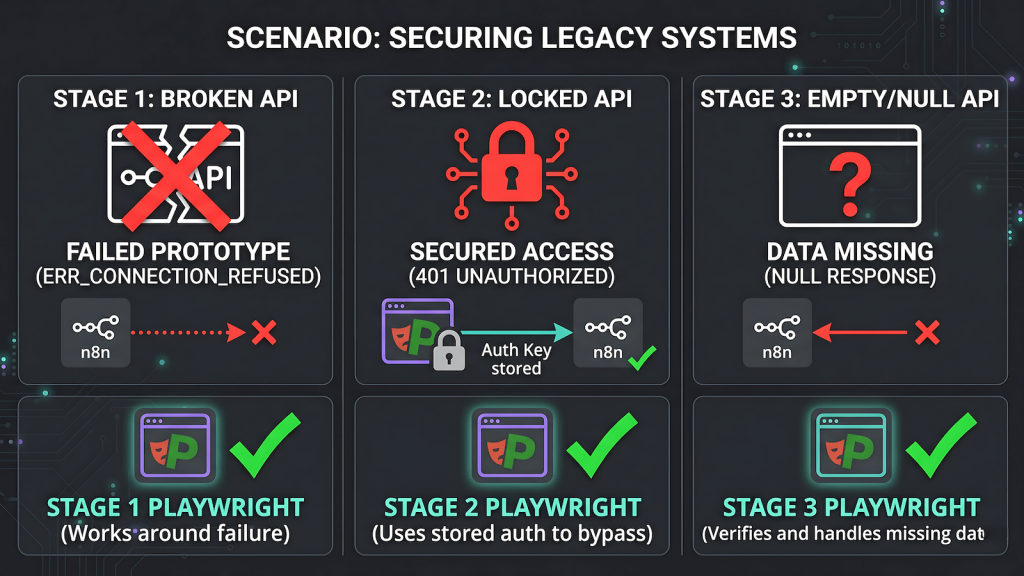
When the API Is Broken
A broken API is the most recoverable situation. The surface exists, the endpoints are documented, and someone on the backend team is presumably responsible for making them work. The automation is blocked but the problem is someone else’s to fix.
The first move is characterization, not escalation. Is the failure consistent across all calls or specific to certain payloads? Does it fail with a 500 and a stack trace, a timeout, a malformed success response, or a 200 with no body? How long has it been failing, is this a new regression or a long-standing known issue? Documenting this precisely is QA work even when no one explicitly asked for it. A well-characterized bug report moves faster than a “the API is broken” comment in a standup.
While the fix is in flight, the coverage question becomes: can the UI exercise the same backend path? If the UI calls the same endpoints or triggers the same business logic, Playwright-based UI tests can maintain coverage while the API is down. This is not a permanent arrangement UI tests are more brittle than API tests and more expensive to maintain but it keeps the coverage from going dark during the outage.
When the API Is Gated
Gated APIs are a different category. The feature works, the endpoint exists and is documented, but it requires an enterprise tier, a manual approval process, or a business relationship that your project does not have. This comes up regularly: read receipts locked behind a premium messaging API tier, webhook configuration available only on paid SaaS plans, bulk operations that require a partner integration agreement.
Playwright automation with no API access is the standard path here. Testing through the UI is not bypassing the gate it’s using the product the way an unprivileged user would. For test coverage purposes, this has its own value: you are exercising the real user experience of the gated feature, including any UX friction, rather than a direct API call that bypasses the interface entirely.
The tradeoff is brittleness. UI-based tests break when the interface changes. The mitigation is standard: use stable selectors anchored to data attributes where possible, keep locator logic isolated in page object files or helper functions, write a smoke test that verifies the UI flow is still navigable before running the full coverage suite. None of this is unique to the gated API scenario, it is just Playwright maintenance practice applied to a constraint-driven setup.
When There Is No API
No API is the most interesting case and the most common one in real-world automation work. The feature exists. Users interact with it. There is no programmatic surface to reach it from outside the browser. Admin consoles, legacy internal tools, third-party publishing platforms with minimal integration suppor, this is more of the automation landscape than API-first thinking accounts for.
This is where playwright automation no api access becomes the only real option rather than a fallback. You drive the UI directly, handle authentication through persistent browser contexts, and build the automation the same way you would build a test suite for a conventional UI. The EchoCast work with Medium is exactly this case with no API, session-based HTTP alternatives that failed after deep investigation, Playwright driving the editor directly. That investigation and what it found is documented at Why Medium’s API Fails and What We Did Instead.
The practical requirements for this approach are a UI stable enough to write reliable locators against, a mechanism for maintaining authentication state across runs, and realistic expectations about maintenance when the UI changes. These are costs, not blockers. They need to be in the plan.
Documenting What You Find
Across all three scenarios, the most durable contribution you can make alongside whatever automation you build is documentation of the finding. Which endpoints are unreliable and under what conditions. Which features have no API coverage and which ones are gated. Which UI flows are being tested because the API does not reach those code paths. This documentation is institutional knowledge. It informs future automation decisions, surfaces coverage gaps for the product team, and does not exist unless someone writes it down.
The security QA post in this cluster, Security QA Without the Security Title is about the same underlying pattern: doing technically substantive work that falls outside the explicit scope of the ticket and making it visible instead of invisible.