Most QA content is written for people learning what testing is. This post is not that. It is for QA engineers who already know the fundamentals, have shipped real products, and are looking for the techniques that separate someone who executes a test plan from someone who understands the system well enough to know where the plan is wrong before the first test runs.
The techniques mapped here are organized by where they sit in the actual QA workflow, not by difficulty level or tool category. You will not find a definition of regression testing or an explanation of why automation matters. What you will find is a sequence of advanced thinking and execution that covers how a senior QA engineer approaches a real engagement from the first look at the system to the last performance run before release.
Each section links to the dedicated QAJ post that goes deep on the technique. This is the map. The posts are the territory.

Phase 1: Before You Test Anything
The work that separates advanced QA from basic QA starts before a test case is written. It is the thinking that happens when you first encounter a system and have to decide where the risk actually lives, how the components connect, and what the failure modes are that the spec never described. Most QA engineers skip this phase because it does not produce a deliverable. The ones who do it produce better coverage with less wasted effort.
Fragmentation as a testing signal. Monolithic systems fail differently than fragmented ones. When a system is built as isolated modules with contained failure boundaries, the QA approach changes because a failure in one area does not cascade the same way it does in a tightly coupled architecture. Understanding how fragmentation affects failure modes changes what you test first and where you look when something breaks in a way that does not match the spec. Why QA Fails Without Fragmentation covers how to read system architecture as a testing signal before writing a single test case.
Abstraction and what it hides from testers. Every layer of abstraction in a codebase hides behavior that a black box test cannot reach. Advanced QA engineers know how to think through the abstraction layers and identify what is being obscured, what assumptions are baked into the interface, and where the implementation can diverge from the contract without triggering any surface-level failure. Abstraction in QA Testing covers how to use abstraction analysis as a coverage planning tool rather than a developer concern.
Branch-level testing before code merges. Running tests against a feature branch before it touches the main codebase is not a new idea, but doing it with the right coverage focus is still rare. Most branch-level testing catches obvious functional failures and misses the integration risks that only appear when the branch-level behavior meets existing system state. Branch-Level QA Testing covers how to scope branch tests around the actual integration risk rather than running a subset of the full regression suite and calling it done.
Phase 2: Designing the Test Approach
Once you understand the system, the next phase is deciding what coverage actually looks like for this engagement, this sprint, this product. Advanced QA engineers do not apply a standard test plan template. They design coverage around the specific failure modes that matter for this product at this stage of development, and they revisit that design as the product changes.
Rebuilding a regression suite that has stopped working. Every QA engineer eventually inherits or builds a regression suite that has grown into a liability. Tests that never fail, tests that fail for the wrong reasons, tests that take three hours to run and catch nothing useful. The advanced skill is knowing when incremental maintenance stops working and a rebuild is the right call, and then knowing how to build the replacement suite around what actually breaks rather than what was convenient to cover the first time. Regression Suite Rebuild covers the decision criteria and the rebuild process from someone who has done it on real projects.
Caching as a QA signal. Caching is one of the most consistently undertested surfaces in web applications because it is invisible to a functional test that runs in isolation. A test that always starts with a cold cache is not testing what a real user experiences after the second visit, the third API call, or the stale session that expired while the tab was still open. Caching as a QA Signal covers how to build caching behavior into your test coverage rather than discovering it in production when a user reports seeing data that should not exist anymore.
Phase 3: Executing with AI in the Loop
The execution phase for advanced QA engineers in 2026 looks different from what it looked like two years ago because AI is now a functional part of the workflow, not an experiment. The engineers using it well are not using it to generate test cases they copy without reading. They are using it as a thinking partner that accelerates the parts of test execution that used to require context-switching out of the testing flow entirely.
Building a one-person AI QA operation. The retainer model for QA work changed what solo execution looks like because AI handles the documentation layer that used to require a separate sitting. Session context stays in the conversation, issues compile into a QA report, and tickets go straight to the project management tool without an intermediate spreadsheet. I Built a One-Person AI QA Agency Using a Skill File and a Local LLM covers the full system including the skill file structure that makes AI output consistent enough to trust.
Testing AI-generated code. When the feature you are testing was built by an AI coding tool, the standard QA approach covers the specified behavior and misses everything the prompt never described. AI-generated code can satisfy every acceptance criterion and still contain logic paths that only surface under conditions nobody anticipated. The test coverage has to go deeper than the spec because the spec was a prompt, not a requirements document. The Hybrid AI QA Workflow covers what that additional layer looks like in practice.
Using AI as a collaborative testing partner on complex systems. The casino game QA engagement is the clearest example in the QAJ library of what AI collaboration on a real project actually looks like at the execution level. Not AI generating test cases from a spec, but AI holding the session context, surfacing edge cases during active testing, and compressing the analysis loop that used to happen after the session into something that happens during it. Casino Game QA Testing: What I Learned Using Claude as a Collaborator is the most detailed account of that collaboration model on QAJ.
Phase 4: Automation That Holds Up
Writing automation scripts is not an advanced skill. Writing automation scripts that survive a production codebase six months after the feature shipped, that do not break every time a designer moves a button, and that provide signal rather than noise when they fail: that is the advanced skill. The posts in this section cover automation engineering at the level where the decisions are about architecture and resilience rather than syntax and selectors.
Visual regression testing with Playwright. Visual regression catches the class of bugs that functional tests cannot: layout shifts, CSS changes, unintended design regressions that break the user experience without triggering a single assertion failure. The advanced challenge is keeping visual tests stable enough to be useful without generating so many false positives that the team stops looking at the failures. Playwright Visual Regression Testing Guide covers how to structure visual tests around the changes that matter rather than capturing pixel-perfect snapshots of everything.
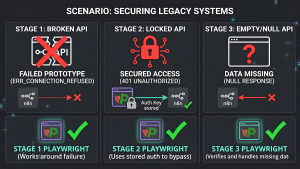
Playwright automation without API access. Most Playwright guides assume you have full access to the application’s API for test setup and teardown. Real engagements often do not work that way. When you are testing a product where the API is locked, undocumented, or simply unavailable for test use, the automation strategy has to change. Playwright Automation Without API Access covers how to build reliable test setup without the shortcuts most guides rely on.
Building a browser automation pipeline. At the point where Playwright tests are running in CI/CD, across multiple environments, with authentication state managed across roles and test isolation enforced across parallel runs, the work is infrastructure engineering as much as test engineering. Building a Browser Automation Pipeline with Playwright covers the architecture decisions that keep a pipeline maintainable as it scales.
Phase 5: Beyond Functional Testing
Functional testing covers whether the product does what it is supposed to do. The advanced layer covers whether it holds up under load, whether it leaks data it should not, and whether it handles the inputs that were never in the spec but show up in production the first week after launch. Most QA engineers treat performance and security as specialist disciplines. Advanced QA engineers treat them as surfaces that belong in every engagement.
Performance testing with k6. Load testing is not optional for anything that will have real users. It is optional for QA engineers who have not done it before and do not know where to start. k6 is the entry point that makes performance testing accessible to QA engineers who are not dedicated performance specialists, and the results it produces are specific enough to be actionable rather than just alarming. k6 Load Testing Tutorial for QA Engineers Who Have Never Done Performance Testing starts from zero and ends with a running load test against a real endpoint.
Security testing without the specialist title. QA engineers already touch every surface of a system: forms, file uploads, authentication flows, API endpoints, session handling. Testing those surfaces for security-relevant behavior is not a separate discipline that requires a penetration testing certification. It requires knowing what correct behavior looks like at each surface and testing against that baseline the same way you test functional behavior. Security Testing for QA Engineers covers the specific test cases that belong in every QA engagement regardless of whether security is in the scope document.