Prompt engineering for QA engineers is not about finding magic words. It is about applying the same discipline you use to write test cases to the instructions you give an AI tool. If your prompts are vague, your output is vague. If your prompts are scoped and specific, your output is actually usable. The gap between a QA engineer who gets consistent value from AI tools and one who gives up after three tries is almost always in how they constructed the prompt, not which tool they used.
This applies whether you are running Claude, ChatGPT, Gemini, or a local model through Ollama. The model changes. The discipline does not.

Why QA Prompts Fail
Most QA engineers approach AI tools the way they approach a search engine. They type a short query, expect a useful result, and adjust when they don’t get one. That works for search because search engines are built to interpret incomplete input. AI language models are built to complete what you start. If you start with something vague, the model completes it plausibly, not accurately.
The most common failure is missing context. A prompt like “write test cases for the login page” gives the model nothing to work with beyond the words login and page. It will produce generic test cases that cover the obvious paths and miss everything specific to your system. The model has no idea whether your login supports SSO, whether there is a lockout policy after failed attempts, or whether the forgot password flow is in scope. It fills those gaps with assumptions, and assumptions in test cases are where coverage holes live.
The second failure is missing output format. If you do not tell the model how to structure the output, it will choose a structure that looks reasonable to a general audience. That structure may not match your test management system, your bug report template, or your team’s conventions. You then spend time reformatting output instead of reviewing it, which erases the time you saved by using the tool in the first place.
The Four Elements Every QA Prompt Needs
A QA prompt that produces usable output consistently has four components. These are not rules invented for AI tools. They are the same elements that make a good test case specification: role, context, scope, and output format.
Role tells the model what kind of thinking to apply. “You are a QA engineer reviewing a checkout flow for an e-commerce platform” produces different output than the same prompt without that framing. The model adjusts its assumptions about what matters, what failure modes to prioritize, and what level of technical detail is appropriate. Role is not decoration. It is the frame that everything else sits inside.
Context is the system information the model cannot know without you providing it. Feature specifications, acceptance criteria, known constraints, tech stack details, user personas, and previous bug patterns all belong here. The more specific the context, the less the model has to assume. Your prompt quality determines your output quality, and context is the biggest variable in that equation.
Scope tells the model what is in and what is out. Without scope, the model will expand to fill whatever space seems reasonable. For a regression test prompt, scope might mean specifying which features were touched in the latest release and which are stable and excluded. For an edge case prompt, scope might mean specifying the input types you care about and the ones already covered elsewhere. Scope prevents the model from generating output that looks comprehensive but covers the wrong ground.
Output format tells the model exactly how to structure the result. If you need test cases in a specific format, describe it. If you need a bug report with severity, steps to reproduce, expected result, and actual result, say so explicitly. If you need a numbered list versus a table versus a prose summary, specify it. Models default to whatever format feels natural for the prompt. Your job is to make the format feel natural by stating it upfront.
Prompt Engineering for QA Engineers in Practice
Here is what this looks like on a real task. Suppose you need edge case test cases for a date input field on a form that feeds into a scheduling system.
A weak prompt: “Give me edge cases for a date input field.”
A prompt with all four elements: “You are a QA engineer testing a scheduling system. The date input field accepts user-entered dates for appointment booking. The system runs in the US and uses MM/DD/YYYY format. The field has a minimum date of today and a maximum date of 12 months out. Leap years are supported. Generate edge case test cases covering boundary values, invalid formats, out-of-range dates, and browser autofill behavior. Format each test case with: test case ID, input value, expected result, and pass/fail criteria.”
The second prompt takes 45 seconds longer to write. It produces output you can drop directly into your test suite instead of output you spend 20 minutes fixing. That tradeoff is not close. Understanding how boundary value and edge case thinking applies to real systems is what lets you write the second prompt instead of the first.
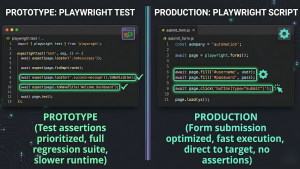
The same structure applies to writing Playwright automation scripts with AI assistance. Role, context, scope, output format. The task changes. The discipline stays the same.
Where Prompt Quality Breaks Down
Even well-structured prompts fail in predictable places. The first is when the context is incomplete because the QA engineer does not fully understand the system yet. You cannot prompt your way out of not knowing what you are testing. If you are new to a feature or a codebase, spend time in the system before you prompt. The model reflects your understanding back at you. If your understanding is shallow, the output will be shallow regardless of how well the prompt is structured.
The second breakdown point is over-reliance on a single prompt. Complex testing scenarios need iterative prompting. Start with a broad prompt to generate a first pass, then follow up with specific prompts that drill into the areas the first pass missed or handled poorly. Treat it the way you treat a testing session: start wide, go deep where the risk is.
The third breakdown is not reviewing the output critically. AI tools generate confident output regardless of whether it is correct. A test case that looks complete can still be testing the wrong thing, using the wrong expected result, or missing a critical constraint. The judgment layer stays with the QA engineer every time. Reviewing AI output with the same critical eye you bring to reviewing a junior tester’s work is not optional. It is the job.
Building Prompts You Can Reuse
The highest-leverage thing a QA engineer can do with prompt engineering is build a personal prompt library. Not a collection of one-off prompts that worked once, but a structured set of reusable templates with the role, context placeholders, scope parameters, and output format already defined. You fill in the system-specific details for each engagement and the structure handles the rest.
A smoke testing prompt template, a regression edge case prompt template, an API response validation prompt template, a bug report generation prompt template. Each one built once, refined over several uses, and reused across every project. The time investment is front-loaded. The return compounds every time you run a new engagement without starting from zero.
This is the same thinking behind a structured QA skill file for AI agents. The structure is the asset. The specific details change per project. The discipline underneath stays fixed. Build the structure once and let it work for you across every context you put it in.