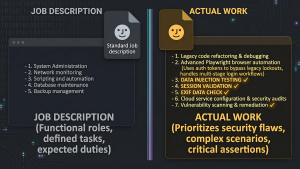
QA engineer skills beyond testing are not optional extras you pick up if you have time. They are the actual job, and the sooner you understand that, the faster you stop being the person who closes tickets and start being the person who protects the product.
The job description says testing. What the job actually requires is enough context in every discipline that touches the product to know when something is wrong before it ships. Scrum, business logic, product management, development, security. Not deep expertise in all of them. Enough. The floor on what “enough” means rises with every level of seniority, and most QA engineers are never told that explicitly until they are already in a role that requires it.
I held QA lead and Head of QA titles simultaneously at a startup where the scope of the work bore almost no resemblance to what those titles implied on paper. I also held PM responsibilities in the same period, not because the team was understaffed or because other roles were failing, but because the product required it and I was the one with enough context to do it. That context did not come from certifications or training programs. It accumulated over years of being the person in the room who had to figure out what was actually being built, what could go wrong with it, and who was responsible for which part of that answer.
The QA vs. PM hybrid role post covers what that dual responsibility looks like in practice. This post is about why it happens and what QA engineers at every level need to know to be ready for it.

Why QA Touches Every Discipline Whether You Plan For It or Not
Quality is not a stage in the development process. It is a property of every decision made during the process. A story written with ambiguous acceptance criteria produces a build with ambiguous quality. A sprint that does not account for test coverage time produces a release with uncovered edge cases. A feature that the developer built correctly but the PM described imprecisely fails in production in ways that nobody anticipated because nobody had the full picture.
QA is the role that sits at the intersection of all of that. Not because QA is responsible for fixing all of it, but because QA is often the first to see when something from another discipline has created a quality gap. A QA engineer who can read a story and identify that the acceptance criteria are too vague to test against is doing product management work. A QA engineer who can look at a sprint plan and flag that testing time has not been accounted for is doing project management work. A QA engineer who can sit in a grooming session and ask the question that surfaces a technical dependency nobody had mapped is doing architecture work.
None of that is outside the QA lane. All of it is QA work done with enough cross-discipline context to be useful.
What QA Engineers Actually Need to Know at Each Level
This is not a call for QA engineers to become generalists who do everything badly. It is a call for enough working knowledge of adjacent disciplines to recognize when something from that discipline is creating a quality risk.
At the tester level, the floor is functional. You need enough understanding of the story and the acceptance criteria to test against them. You need enough business context to know when something that technically passes still does not serve the user. You need enough development awareness to understand why a bug is happening, not just that it is happening. That last one is what separates a bug report that a developer can act on from one that sends them back to ask four clarifying questions before they can start.
At the senior level, the floor rises. You need enough Scrum knowledge to participate in grooming and planning with something to contribute beyond the test estimates. You need enough product understanding to identify when a feature is being built correctly but specified incorrectly. You need enough security awareness to know which of your test cases are also security tests even if nobody scoped them that way. The security testing for QA engineers post is a direct example of what that awareness looks like when it gets applied to a real product.
At the lead level, the floor rises again. You need enough PM instinct to know when a sprint is being loaded in a way that will compromise test coverage and say so before the sprint starts rather than after. You need enough business context to make go/no-go calls that account for product risk, not just test pass rates. You need enough team management context to know when a QA engineer on your team is struggling in a way that will affect delivery and address it before it becomes a sprint problem. And you need enough of all the disciplines above to train your team on the gaps you see, the same way I started training my team on security patterns after I realized HackerOne tickets were landing in our queue and nobody had the context to handle them.
Skills That Age Badly
There is a version of QA that is becoming harder to sustain and most people inside it do not see it until the contraction is already happening.
Manual-only regression does not scale and is increasingly the first thing cut when budgets tighten. Tool-only knowledge, knowing Selenium but not understanding why the test is failing at the architecture level, makes you replaceable the moment the team switches frameworks. Executing test cases without analysis means you are producing output but not judgment, and judgment is what the role actually pays for at senior and lead levels. Filing bug reports without explaining business impact means the developer and PM have to do the translation work you should have done before submitting the ticket.
None of these skills are worthless on their own. The problem is relying on them alone. A QA engineer whose entire value proposition is execution without analysis has a ceiling that arrives earlier than they expect. The QA engineers who survive role consolidation and team restructuring are the ones whose value cannot be reduced to a checklist.
Technical Growth vs Career Durability
This is the distinction that almost nobody names plainly and it explains why some QA engineers plateau while others keep moving.
Technical growth is the visible layer. API testing, automation frameworks, SQL, CI/CD pipelines, performance testing with k6, observability tooling, AI-assisted validation. These skills get you hired. They expand your scope. They make you more useful across a wider surface of the product. They are worth building deliberately and the QA automation framework choice post covers how to think about that stack without chasing every new tool that appears.
Career durability is the layer underneath. Risk communication, the ability to explain a quality gap in terms of business impact rather than test count. Business context, knowing enough about what the product is trying to do to identify when a technically passing feature is going to fail the user. Triage judgment, the ability to make a severity call under pressure and defend it. Stakeholder negotiation, the ability to hold a go/no-go position when the pressure to ship is coming from above. Release confidence, the ability to say this is ready or this is not and own that call.
Seniors get promoted on the second list. Almost always. The technical layer gets you to the table. The durability layer determines how long you stay there and how much influence you have once you arrive.
If you are doing remote QA work and trying to build both layers without the informal knowledge transfer that happens in an office, the remote tech jobs QA guide covers the landscape of what that actually looks like right now.
What the Team Looks Like When Everyone Knows Enough
The best sprint dynamic I ever worked in ran grooming sessions that lasted three to four hours. Not because the team was inefficient. Because everyone in the room had enough context in enough disciplines to contribute something real to every item on the board.
The PO suggested what was needed from a business perspective. The PM gatekept what went into the sprint based on capacity, priority, and dependency. The dev lead managed his team’s bandwidth and raised technical constraints. I raised QA risk and coverage gaps and deferred to the PM on prioritization. Nobody was protecting their lane out of insecurity. Everyone was contributing from their lane because the environment made it safe and worthwhile to do so.
That dynamic does not come from a process framework. It comes from a team where everyone has been exposed to enough of each other’s disciplines to understand what the person in the next seat is actually responsible for. When a PM makes a call that deprioritizes a test coverage gap, a QA lead who understands PM thinking knows that it is a risk management decision, not a dismissal. When a developer pushes back on a bug severity rating, a QA engineer who understands development knows when the pushback is technically valid and when it is not.
The QA to Scrum Master path post covers what happens when QA engineers pursue that Scrum knowledge deliberately rather than picking it up by accident.
The Cross-Discipline Knowledge That Gets Missed Most Often
Security is the most common gap. Most QA teams never test the security layer because it was never in scope, and they do not have the pattern recognition to know what they are looking at when a security issue surfaces. The API security testing for QA engineers post covers exactly this, written from the experience of learning it through HackerOne triage and applying it on a free afternoon out of curiosity.
Business logic is the second most common gap. A QA engineer who only validates that the happy path works is not testing the product. They are testing one scenario of the product under ideal conditions. The business logic layer, what happens when a user does something the developer did not anticipate, is where real quality lives and where most test suites have the least coverage.
Scrum literacy is the third. A QA engineer who does not understand sprint planning has no leverage to protect testing time during planning. They find out at the end of a sprint that two days of coverage got cut because the sprint was over-committed, and they have no language for the conversation that should have happened at the start. That is not a Scrum problem. It is a cross-discipline knowledge gap.
The Uncomfortable Truth About Where This Is Heading
The more AI writes code, the more expensive bad assumptions become.
AI tools generate code fast. They do not generate context. They do not know what the business actually needs, what the user actually does, or what the edge case looks like when three valid inputs collide in production in a way nobody anticipated. They produce output. Someone still has to validate that the output is correct, complete, and safe.
That someone is QA. And the value of that role is not shifting downward into faster execution of more test cases. It is shifting upward into validation, reasoning, system integrity, and trust enforcement. The QA engineer who can look at an AI-generated codebase, understand its assumptions, identify its gaps, and make a defensible go/no-go call is not a tester. They are a trust layer between the product and the user.
Role boundaries across the entire software team are already collapsing. QA engineers are being pushed horizontally into API automation, CI/CD, Docker, cloud logs, observability, and AI-assisted validation, not because it is trendy but because the boundaries between those disciplines and quality assurance were always artificial. The QA engineers who thrive in that environment are not the ones who executed tests fastest. They are the ones who understood the most.
That has always been the job. The industry is just catching up to what it actually requires.
Knowing Enough Is the Career Skill
I was not promoted to lead because I was the best tester on the team in the narrow sense. I was promoted because I had seen more patterns across more disciplines than anyone else in the room and I knew how to apply them when something unusual landed on my desk. That range came from exposure, from titles that did not match the actual scope of the work, from HackerOne tickets nobody else wanted to touch, from sprint meetings where I asked questions that turned out to be the right questions because I had enough PM context to know what the PM was trying to decide.
For QA engineers who want to grow beyond ticket closure and into genuine product protection, the path is not deeper specialization in testing alone. It is wider exposure to the disciplines that feed into what you test. You do not need to be a developer, a PM, a Scrum Master, or a security engineer. You need to know enough of what each of them does to recognize when their work is creating a quality risk.
If you are doing remote QA work and navigating the added complexity of cross-discipline collaboration without being in the same room as the team, the remote tech jobs QA guide on RWH covers the landscape of what that actually looks like in practice right now.
The button clicking and the scripting are the visible outputs. The breadth is the skill that produces them.