Some QA engineers are now being asked to help build the AI agent that could replace them, and whether AI will replace QA engineers has turned into a question people ask out loud. AI already went through marketing, advertising, media, digital creatives, research, business and software development. QA sits right downstream of all of that, so QA is next in the pipe, and the future of QA with AI is back on the table.
As for whether I’d help build it, I’m already building an AI QA team of my own, and I’ve spent months testing software that an AI dev agent wrote. I’m not going to tell you humans are better at QA, and I’m not going to tell you AI is. AI can’t touch everything, it’s all perspective, and the change that matters is that we can’t stay rigid about who does the work, so we build a system that works with AI or we get left behind.
Companies Can Automate QA and Still Go Looking for Someone
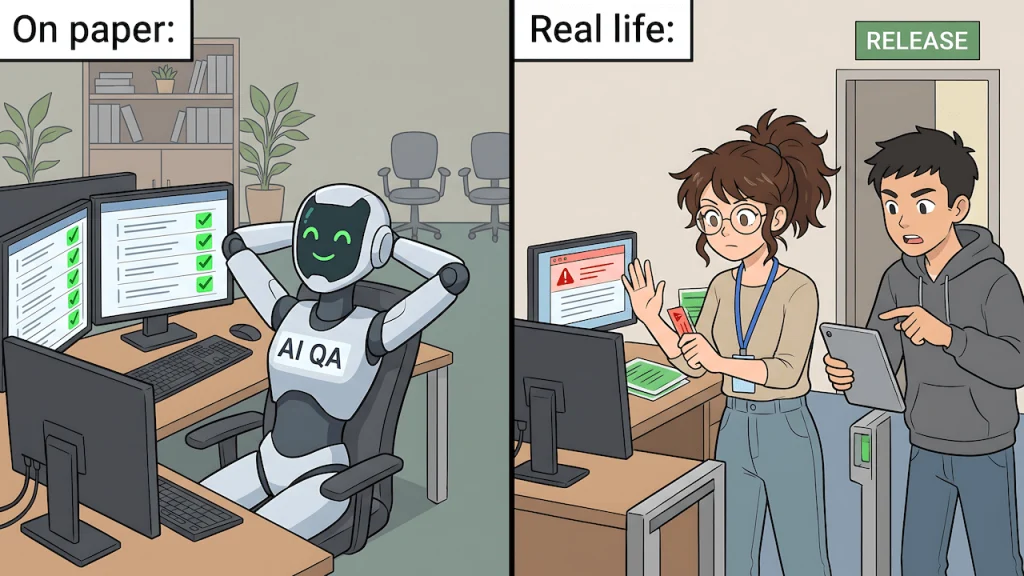
Companies can automate QA, and companies can hire someone to take the work over. That’s real, and it’s going to happen at some of them. In the end, though, they still look for someone to own it, or the person who got replaced ends up in a newer position, because somebody still has to own the result.
Layoffs will happen, and nobody can put a date on them. That doesn’t mean most companies will adopt an AI QA agent, and it doesn’t mean most won’t. It’s a read on where this is heading, not a number, and I’m treating it that way.
You Get Left Behind Either Way
Stick to all human and you get left behind. The dev side is moving faster than it ever has, which means more code arrives with less human review baked in anywhere else in the pipeline. A QA team that refuses to touch AI keeps checking by hand at a pace the code no longer waits for.
Stick to all AI and you get left behind too. One model, one prompt and one pass with no review is how most AI QA gets used, and a model reviewing its own work misses the same things it missed the first time. It can also pass every check against the spec while the behavior you know is real never gets tested.
Both of those are rigid, and rigid is the problem. What works is building the arrangement between the two on purpose, and that’s what using AI for QA actually takes. That means deciding up front what the AI handles and what the human keeps.
A Wrong Implementation Makes More Work for the Human
Drop an AI QA agent into a team with no structure and the human ends up cleaning up after it. Someone has to prep the data, tighten the scope, and automate the pieces around it so the agent can do its job properly. Then someone has to review what it did, which means the human picked up the agent’s work on top of their own.
I’ve seen what loose looks like on a real project. An agent fixes the stated issue and also refactors a component next to it, or a fix passes the acceptance criteria and still changes behavior nobody asked for. Nobody caught it until a human went looking at the adjacent surfaces, because the agent doesn’t ask what sits next to the thing it was pointed at.
The agent isn’t the problem in any of that. The implementation is. When the system around it is loose, QA turns into babysitting.
What AI Coders Already Figured Out
I use Claude Code and ChatGPT Codex, and I’m familiar with the code they touch, so I double check it. I have to, because I’m the one who knows what that code is supposed to do. Even with AI writing the code, there’s still a point where a specialist has to look at what it’s doing.
Developers worked out how to handle this a while ago. Keep the code short, under 500 lines, or even 100. Refactor it. Be deliberate about which libraries get used. Write cleaner, shorter code. Split it across multiple files so each one does one thing and what it does stays isolated. That’s how AI coders are still being tested right now.
Most people have already integrated them nicely, and they kept a person operating it and kept it lean. Why? Because sooner or later something will fall, or something will break. When it does, a lean setup with one job per file tells you where to look, and a giant blob tells you nothing.
The Same Rule Applies to an AI QA Agent
QA works the same way, and AI in QA testing is no exception. Whether you call it AI QA or AI quality assurance, you’re trying to minimize the breakage and raise the quality, and at the same time you’re still monitoring the one doing it. That’s what human in the loop QA actually means. It isn’t a person approving everything, it’s a person who knows the system well enough to see when it’s off.
Small scope and small checkpoints are how that looks in practice. On my QA retainer every ticket covers one surface, every one carries a scope boundary that says what the fix touches and what it doesn’t, and every fix gets a verification comment before it closes. An agentic QA setup that tries to cover everything at once is the giant single file nobody wants to touch.
That’s also why you still need a team to handle it. Somebody has to own the AI QA agent the same way somebody owns the code, and somebody has to hold the context between sessions, because the agent doesn’t remember what was tested last week. Take the people out and you’ve kept the speed and lost the part that catches the breakage.
This Is What My QA Articles Already Show
None of this is new for me, because I’ve been running it. The full loop on the retainer, where a SaaS built by an AI dev agent gets a human verification layer, is in the hybrid QA workflow for AI generated code. The AI QA team post applies the same idea to the AI itself, with one model doing the Jr QA work, another challenging it like a Sr QA, and the QA lead making the final call.
The limits show up in the same place every time. AI testing passes the spec and still misses what you know is real, happy path testing changes when your dev team uses AI, and how AI is changing software testing all land in one spot: the AI gets the scaffolding and the human keeps the judgment. On EngineeredAI I covered the team side in what an AI human dev team workflow looks like and the personal side in what AI actually replaced in my workflow.
So, Will AI Replace QA Engineers?
My answer isn’t a yes or a no. AI will take over parts of the work, and companies will handle it in different ways. What decides how it goes for a team is the system around the AI QA agent: a lean scope, small checkpoints, and a person who stays on it because something will break.
That’s the whole stand. Don’t be rigid about replacing the person, and don’t be rigid about keeping AI out. If your team is about to put an AI QA agent in the loop and you’re not sure where the human checkpoints go, start with the hybrid QA workflow for AI generated code and go from there.